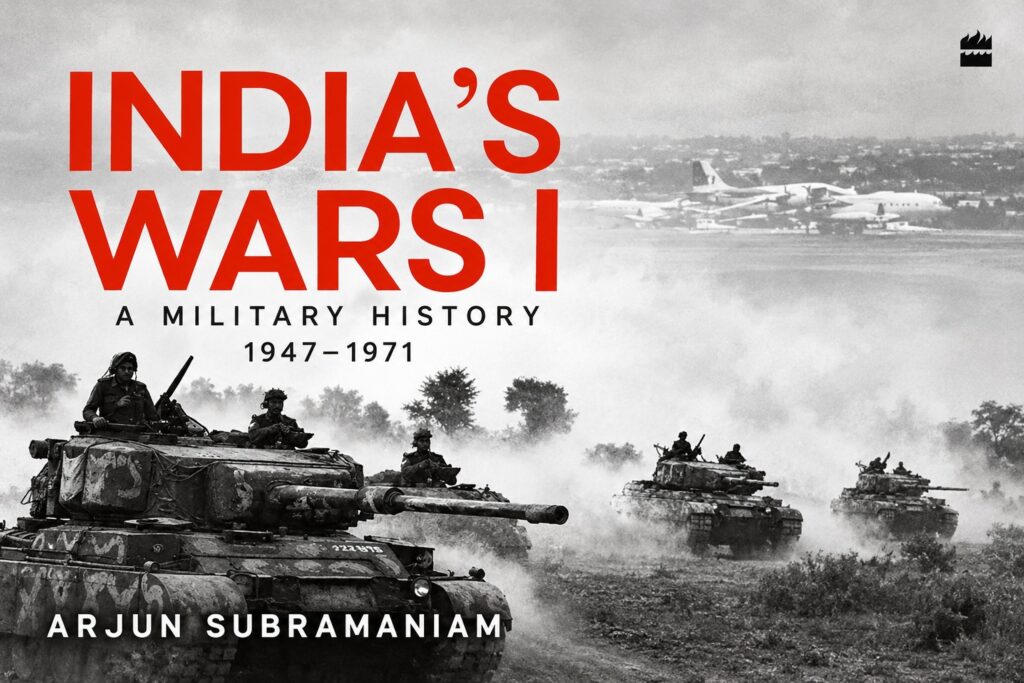

India’s Wars: 1947–1971 by Air Vice Marshal Arjun Subramaniam is a compelling account of the military history of independent India during its formative years. The book explores the challenges faced by the Indian armed forces between 1947 and 1971, a period marked by territorial disputes, political uncertainty, and major military confrontations. Through a detailed examination of wars, military operations, and strategic decisions, the author presents a comprehensive picture of how India developed its defence capabilities after gaining independence.
The book covers some of the most significant events in modern Indian history, including the First Kashmir War of 1947–48, the Sino-Indian War of 1962, the Indo-Pakistani War of 1965, and the Bangladesh Liberation War of 1971. Rather than presenting these conflicts merely as a sequence of battles, Subramaniam examines their political background, operational challenges, leadership decisions, and consequences for India’s national security.
About the Author
Arjun Subramaniam is a retired Indian Air Force officer, military historian, and author known for his research on India’s military history. His professional experience and academic approach contribute to the credibility and depth of his writing. He combines historical research with an understanding of military strategy, making his work valuable to both general readers and students of defence studies.
His writing seeks to explain not only what happened during these wars but also why particular decisions were made and how they influenced India’s military and political future.
Summary of the Book
The book begins with India’s independence in 1947, when the country faced enormous challenges in establishing its military and securing its borders. Partition had created political instability, mass displacement, and disputes over territories, particularly Jammu and Kashmir. The First Kashmir War of 1947–48 became an early test of India’s military leadership and operational capabilities. The conflict highlighted the difficulties of defending strategically important regions while the newly independent nation was still organising its institutions.
Subramaniam then examines the development of India’s military preparedness during the following decade. The country faced the challenge of balancing national development with defence expenditure while navigating complicated relationships with its neighbours. These years demonstrated the importance of intelligence, logistics, leadership, and long-term strategic planning.
One of the book’s most significant sections concerns the Sino-Indian War of 1962. The conflict exposed serious weaknesses in India’s military preparedness, equipment, intelligence assessments, and operational planning. The defeat against China became a turning point in Indian defence policy. The author examines the circumstances that contributed to the setback and the lessons it offered about the consequences of inadequate preparation and unrealistic strategic assumptions.
The narrative then moves to the Indo-Pakistani War of 1965. This conflict demonstrated the growing capabilities of India’s armed forces and the importance of coordination between the army and air force. It also revealed the limitations of military power when political objectives, battlefield developments, and diplomatic pressures interact. The war ended with the Tashkent Declaration in January 1966, but many of the underlying tensions between India and Pakistan remained unresolved.
The final part of the book focuses on the events leading to the Indo-Pakistani War of 1971 and the creation of Bangladesh. Political tensions in East Pakistan, the repression following the 1970 elections, and the resulting humanitarian crisis led to a massive refugee influx into India. As the crisis intensified, military intervention became increasingly likely.
The 1971 war marked a decisive moment in India’s military history. India’s armed forces conducted coordinated operations across different fronts, while diplomatic efforts and strategic planning shaped the wider conflict. The surrender of Pakistani forces in Dhaka on 16 December 1971 led to the emergence of Bangladesh as an independent nation. The victory demonstrated the importance of clear political objectives, joint military planning, effective leadership, and careful preparation.
Through these conflicts, Subramaniam illustrates how India’s armed forces evolved from the challenges of the immediate post-independence period into a more experienced and capable military institution.
Major Themes of the Book
1. Evolution of India’s Military
One of the central themes is the transformation of India’s armed forces between 1947 and 1971. The early years were characterised by institutional challenges and limited resources. Successive conflicts forced the military to adapt, improve its capabilities, and reconsider its strategic priorities.
2. Leadership and Decision-Making
The book highlights the influence of political and military leadership on the outcomes of wars. Decisions concerning troop deployment, intelligence, equipment, and operational timing often determined the success or failure of military campaigns. The account encourages readers to recognise that military outcomes depend on more than courage and numerical strength.
3. Lessons from Defeat and Victory
The contrasting experiences of 1962 and 1971 provide important lessons in military preparedness. The 1962 defeat revealed the consequences of weaknesses in planning and capability, while the 1971 victory demonstrated the value of preparation, coordination, and well-defined objectives. The book presents military history as a process of learning and institutional development.
4. The Relationship Between Politics and War
Subramaniam demonstrates that wars cannot be understood independently of their political context. Territorial disputes, diplomatic relations, domestic developments, and international pressures shaped India’s decisions throughout the period. The book therefore offers a broader understanding of warfare as an extension of political objectives.
5. The Role of the Armed Forces in Nation-Building
The military conflicts discussed in the book were closely connected to India’s efforts to preserve territorial integrity and establish itself as a sovereign state. The armed forces played a significant role in responding to external threats and protecting national interests during a period of considerable uncertainty.
Writing Style and Presentation
The author’s writing combines historical detail with military analysis. He discusses campaigns, strategic decisions, and operational developments while explaining their wider significance. This approach makes the book more informative than a straightforward chronology of battles.
Although the subject involves military terminology and complex operations, the historical narrative provides context that helps readers understand the major events. Readers with an interest in military studies may particularly appreciate the discussion of strategy, logistics, and the relationship between political leadership and battlefield decisions.
However, some sections may feel demanding for readers unfamiliar with military history. The number of events, personalities, and strategic considerations requires concentration. A basic understanding of India’s post-independence history would make the reading experience more rewarding.
Strengths and Limitations
The greatest strength of India’s Wars: 1947–1971 is its broad historical perspective. By examining several conflicts within a single narrative, the author allows readers to compare India’s military experiences and understand how earlier setbacks influenced later developments. The inclusion of political and strategic context also prevents the wars from being reduced to simple stories of victory and defeat.
Another strength is the book’s emphasis on lessons learned. It encourages readers to think critically about preparedness, leadership, intelligence, and coordination rather than viewing military success as inevitable.
One possible limitation is that readers seeking a purely personal or emotional account of war may find the analytical approach less engaging. The focus is largely on military history and strategy rather than extended individual soldier narratives. Nevertheless, this approach suits the book’s purpose of examining India’s military evolution.
Conclusion
India’s Wars: 1947–1971 is an informative and thought-provoking work for anyone interested in India’s military history and its development as an independent nation. By covering the conflicts of 1947–48, 1962, 1965, and 1971, Arjun Subramaniam presents a valuable account of the challenges that shaped India’s defence policies and military institutions.
The book’s greatest lesson is that military strength is built through preparation, sound leadership, institutional learning, and the ability to adapt to changing circumstances. The contrast between the setbacks of 1962 and the achievements of 1971 illustrates the importance of learning from past experiences.
Overall, this book is recommended for students of history, defence studies, political science, and international relations, as well as general readers who wish to understand the military events that shaped modern India. It offers more than a record of wars; it provides insight into the strategic decisions and historical experiences that influenced India’s journey during its first twenty-five years of independence.
For more Book reviews amarasage.com