
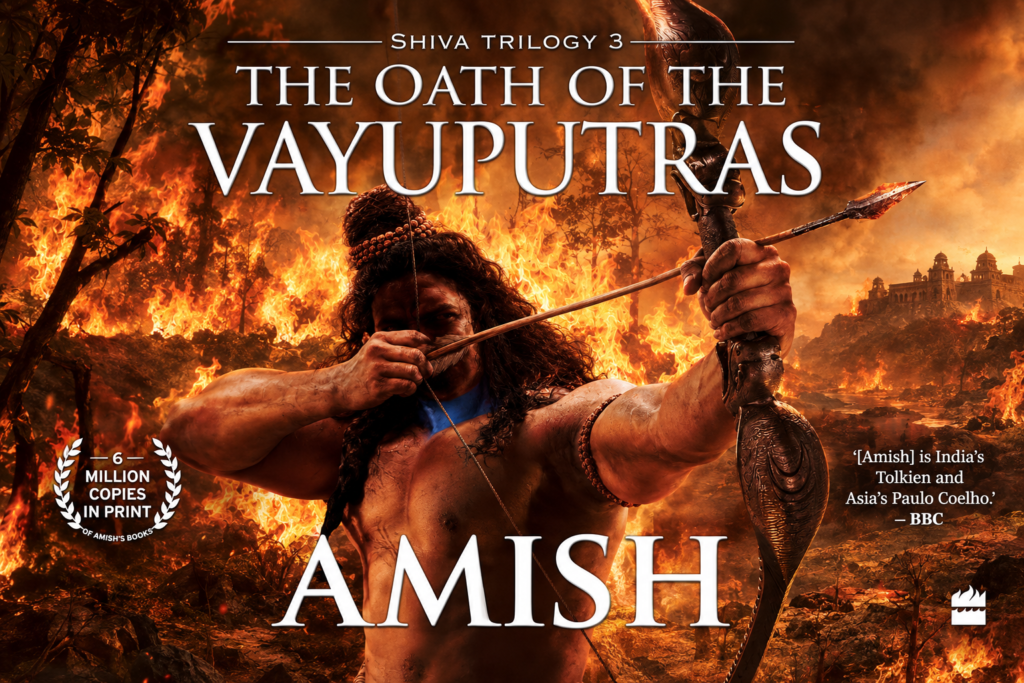

When Myth Becomes Legend
There are some stories that entertain us, some that challenge our understanding of the world, and a rare few that make us look at familiar legends with completely new eyes. The Oath of the Vayuputras, the concluding volume of Amish Tripathi’s celebrated Shiva Trilogy, is a historical fiction that belongs to the third category.
Following The Immortals of Meluha and The Secret of the Nagas, the novel brings the journey of Shiva to its dramatic and devastating conclusion. Amish takes one of India’s most revered mythological figures and places him in a world of political intrigue, warfare, moral dilemmas, love, loss and questions about good and evil.
What makes the trilogy particularly fascinating is that it does not present Shiva simply as an all-powerful god. Instead, Amish imagines him as a human being whose choices, actions and courage gradually lead people to regard him as the Neelkanth—the blue-throated one.
A War Beyond Good and Evil
At the heart of The Oath of the Vayuputras is the impending conflict between Shiva and the forces associated with the Nagas and Meluha. But the novel’s greatest strength is that it refuses to make the conflict a simple battle between good and evil.
Amish repeatedly questions the idea that morality can be divided into neat categories. Characters who initially appear righteous have their flaws, while those considered dangerous or evil often have understandable motivations.
Shiva: The Man Behind the Myth
Shiva remains the emotional centre of the trilogy, and his transformation reaches its most powerful stage in this final book. He is no longer simply the outsider who arrived in Meluha. He has become a leader whose decisions affect entire civilizations. Yet despite his growing stature, he remains deeply human capable of anger, love, doubt, grief and mistakes. This is perhaps Amish’s most interesting interpretation of Shiva.
Rather than portraying divinity as something predetermined, the novel suggests that greatness can emerge from one’s actions. Shiva becomes extraordinary because of the choices he makes, the responsibilities he accepts and the sacrifices he is willing to endure. His journey therefore becomes more than a mythological adventure. It becomes a story about leadership and responsibility.
The Vayuputras and the Mystery
The title itself refers to the mysterious Vayuputras, a powerful group connected to the larger mythology of the Neelkanth. Their arrival adds another layer to the story and helps explain some of the mysteries that have developed throughout the trilogy. Amish gradually reveals their role while expanding the world beyond Meluha and Swadweep. Their presence gives the final book a sense of scale that is appropriate for the conclusion of this historical fiction trilogy.
However, the sheer number of characters, political alliances and mythological elements can occasionally make the narrative difficult to follow. Readers who have not read the first two books may find the third volume particularly overwhelming.
Love, Loss and Sacrifice
While the novel contains battles and political conflict, its emotional power comes from its treatment of relationships. Shiva’s relationship with Sati remains one of the most important emotional threads of the trilogy. Their love is not merely a romantic subplot; it influences Shiva’s identity, motivations and understanding of his own destiny. The novel also explores friendship, loyalty and sacrifice. Several characters are forced to choose between personal desires and what they believe is the greater good. These moments give the story emotional weight and prevent it from becoming merely an action-driven mythological fantasy.
The Philosophy of Evil
One of the most compelling ideas in The Oath of the Vayuputras is the concept that evil may not always begin with evil intentions. The trilogy repeatedly demonstrates how fear, ambition, ideology and the desire to protect society can lead people toward destructive decisions.
This makes the book surprisingly relevant beyond its mythological setting. Modern societies too often divide people into heroes and villains without examining the circumstances that shape their actions. Amish encourage the readers to question these simplistic divisions. The novel’s philosophy can therefore be summed up in one central idea: Good intentions don’t erase the impact.
The World of the Shiva Trilogy
Amish’s greatest achievement is perhaps the world he creates.
Meluha, Swadweep, Panchavati and the other locations feel like parts of an enormous civilization rather than simple settings for a fantasy story. Political systems, military strategies, medicine, religion and social customs are woven into the narrative.
The author combines mythology with elements of history, imagination and speculative interpretation. This creates an India that feels familiar and unfamiliar at the same time. For readers interested in Indian historical fiction, this reinterpretation is particularly engaging because it encourages them to revisit stories they may have grown up hearing.
Writing Style
Amish writes in a straightforward and accessible style. His prose is not overly complicated, which makes the trilogy easy to read despite its enormous scope. The action sequences are fast-paced, while the philosophical conversations slow the narrative down and allow the reader to reflect on the larger ideas.
At times, however, the book can feel excessively detailed. Some sections involving politics, strategy and explanations of mythology may seem lengthy. The narrative also occasionally becomes predictable, particularly because the reader already knows that the story is moving toward a mythological conclusion. Nevertheless, the scale and ambition of the novel compensate for these weaknesses.
What Works Best
The greatest strength of The Oath of the Vayuputras is its ability to make mythology feel contemporary.
Amish do not simply retell the story of Shiva. He asks what might happen if the myth were interpreted through the lens of politics, science, warfare and human psychology. The book also succeeds because its characters are not entirely perfect. They make mistakes, experience doubt and sometimes act out of emotion. This humanity makes the mythology accessible.
What Could Have Been Better
The novel is not without flaws. Its large cast can sometimes become confusing, especially when multiple characters and political groups enter the story simultaneously. The pacing is also uneven, with some sections moving rapidly while others become heavily explanatory.
Readers looking for a traditional retelling of Hindu mythology may also find Amish’s interpretation unconventional. The trilogy deliberately takes creative liberties, and it should therefore be approached as historical fiction rather than a literal account of religious tradition.
Final Verdict
The Oath of the Vayuputras is an ambitious conclusion to a trilogy that changed the landscape of Indian mythological fiction. Its greatest achievement is not the battles, the supernatural elements or even the mythology. It is the way it encourages readers to question familiar ideas about good, evil, morality, leadership and destiny.
Shiva’s journey ultimately becomes a journey from man to legend—but the novel reminds us that legends are created through choices. For readers who enjoy mythology, fantasy, historical fiction, The Oath of the Vayuputras is an engaging and thought-provoking read. It may not be a perfect novel, but it is certainly an unforgettable one.
A sweeping conclusion to Amish Tripathi’s Shiva Trilogy that transforms mythology into a story about power, morality, love, sacrifice and the choices that create legends.
For more book reviews visit amarasage.com



Great review! Sounds like a fascinating read for mythology lovers. 📚✨