
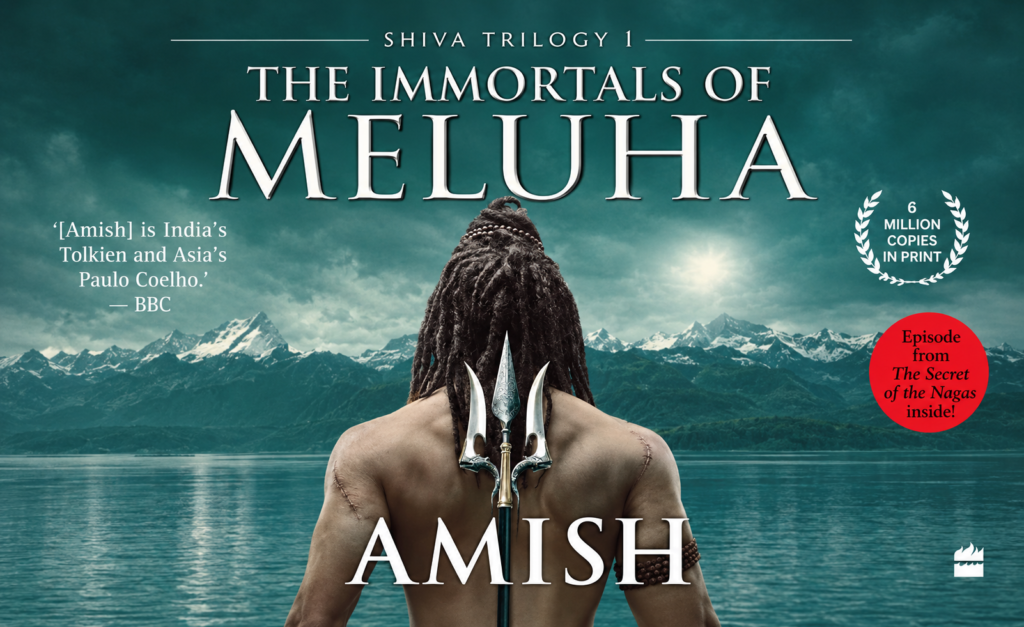

A Myth Reimagined for the Modern Reader
There are some stories that belong to history, some that belong to mythology, and a rare few that manage to exist beautifully between the two. The Immortals of Meluha, the debut novel by Amish Tripathi, is one such story. Published in 2010, the first book of the Shiva Trilogy takes a figure deeply rooted in Indian mythological fiction and reimagines him through the lens of fiction, philosophy, politics, love, and human conflict.
At the heart of the novel is a fascinating question: What if the Gods we worship were once human beings whose extraordinary deeds transformed them into legends? Amish builds his entire narrative around this idea, creating a fictional world that feels simultaneously ancient and surprisingly contemporary.
The Story
The novel begins in the land of Meluha, a prosperous and highly organised kingdom inhabited by the Suryavanshis. Their society is built around discipline, order, justice, and an elaborate belief system centred on the Neelkanth—the prophesied saviour who is destined to protect them from their enemies.
Into this world arrives Shiva, a tribal chief from the land of Tibet. Initially, he is simply a warrior trying to protect his people. But after migrating to Meluha with his tribe, Shiva is unexpectedly identified as the Neelkanth. What follows is not merely the story of a warrior becoming a god. It is the story of a man trying to understand what it means to be regarded as divine.
Shiva is introduced as a flawed, impulsive, emotional and occasionally irreverent character. His transformation is therefore gradual. Rather than presenting him as an already perfect deity, Amish portrays him as a human being whose choices, courage and willingness to question the established order gradually shape his legendary identity. The central conflict revolves around the Suryavanshis and their ideological opponents, the Chandravanshis. As Shiva learns more about Meluha, he begins to question the simple distinction between good and evil. The novel gradually reveals that morality is rarely as straightforward as it first appears.
A Fresh Interpretation of Mythology
Perhaps the greatest strength of The Immortals of Meluha is its treatment of Indian mythology. Amish does not simply retell familiar stories. Instead, he takes mythological characters, symbols and concepts and places them within an alternative historical framework. Shiva becomes a character who can be understood as both a man and a god.
This approach makes the novel particularly accessible to younger readers and to those who may not normally read mythology. The author also uses familiar cultural ideas—such as the concept of karma, the Neelkanth, the Somras and the divine trinity—and gives them fictional explanations. The result is a world where mythology feels tangible.
At times, however, this approach can also be controversial. Readers deeply familiar with traditional Hindu mythology may find some interpretations very different from conventional religious narratives. The novel is best understood as mythological fiction rather than a retelling of scripture.
Shiva: A God with Human Flaws
Shiva is undoubtedly the most compelling aspect of the novel. Rather than portraying him as distant or flawless, Amish gives him very human qualities. He gets angry, falls in love, makes mistakes, questions authority and sometimes acts impulsively. This makes his journey particularly engaging. His relationship with Sati is another important element of the narrative. Sati is not simply presented as a romantic interest. She is a strong character with her own history, conflicts and ambitions. Their relationship develops alongside the larger political and philosophical story. Through Shiva, the novel explores an intriguing idea: perhaps divinity is not about perfection but about the choices a person makes.
Meluha as a World
The fictional kingdom of Meluha is another fascinating feature of the novel. Amish creates an elaborate society with its own political structures, military organisation, religious beliefs and social hierarchy. The descriptions of Meluhan cities, temples, rivers and settlements give the story a cinematic quality. The Suryavanshi obsession with order provides an interesting contrast to Shiva’s more instinctive personality. Their society believes that rules and systems are essential for maintaining civilization, while Shiva repeatedly demonstrates that rigid systems can also become oppressive. This conflict between order and freedom becomes one of the novel’s central themes.
Themes Beyond Mythology
Although The Immortals of Meluha is marketed primarily as mythological fiction, its themes extend far beyond mythology. The novel explores the nature of good and evil, the consequences of political power, the danger of unquestioned beliefs, social discrimination, religious interpretation and the tension between individual freedom and social order.
One of its most interesting ideas is the concept of evil. The novel asks whether evil is determined by appearance, social identity or ideology—or whether actions should be the true measure of morality. This makes the story more than an adventure novel. Beneath the battles and mythology is a philosophical debate about how societies define righteousness.
Writing Style
Amish’s writing is straightforward and accessible. He does not use excessively complicated language, which allows the story to move quickly. The novel is particularly visual. Many scenes seem designed for the imagination of a filmmaker: grand temples, dramatic battles, mysterious rituals, elaborate cities and moments of supernatural discovery. However, the writing can occasionally feel uneven. Some dialogues are more explanatory than natural, and certain sections spend considerable time explaining the world’s political and mythological systems. For readers who prefer subtle world-building, these explanations may feel excessive. But for readers encountering this fictional universe for the first time, they provide useful context.
What Makes the Book Memorable?
The biggest achievement of The Immortals of Meluha is its ability to make an ancient cultural figure feel contemporary. Shiva is not merely a distant deity from mythology. He becomes a character who struggles with love, responsibility, morality and destiny. The book also demonstrates the possibilities of Indian mythology as a source of contemporary popular fiction. It opened the door for a new wave of Indian historical and mythological fiction and showed that stories inspired by Indian traditions could reach a wide modern readership.
Final Thoughts
The Immortals of Meluha is ultimately a story about transformation.
It is the transformation of Shiva from a tribal leader into a figure regarded as divine. It is also the transformation of familiar mythology into a modern fictional narrative. The novel may not appeal equally to every reader. Those looking for strict adherence to traditional mythology may find Amish’s reinterpretations unconventional. Some readers may also find the exposition-heavy portions slow. Yet the novel’s imaginative premise, accessible storytelling and philosophical questions make it an engaging read.
What stays with the reader is the central idea that greatness may not come from being born extraordinary, but from the choices one makes when faced with extraordinary circumstances. For anyone interested in Indian mythology, historical fiction, fantasy, or stories that question the boundaries between humanity and divinity, The Immortals of Meluha offers an intriguing journey.
It is not simply a story about a God. It is a story about a man who becomes a legend—and the choices that make him worthy of becoming one.
For more book reviews visit us at amarasage.com