
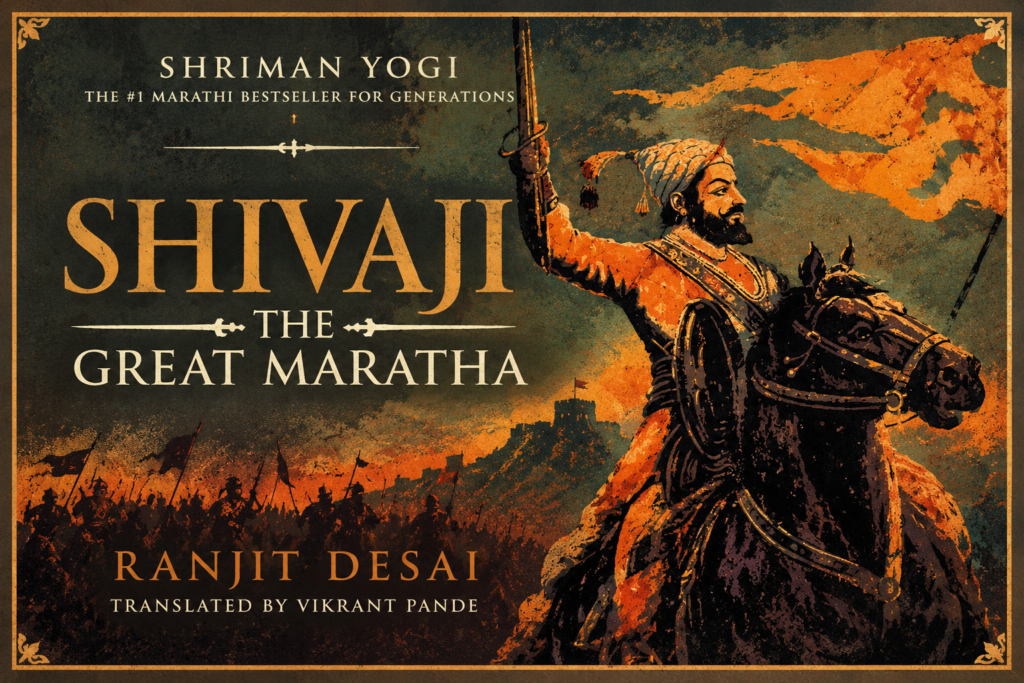

Ranjit Desai’s Shivaji: The Great Maratha is a sweeping historical novel based on the life of Chhatrapati Shivaji Maharaj, one of the most significant figures of seventeenth-century Indian history. Originally written in Marathi as Shriman Yogi, the novel was published in 1968 and subsequently became an important work of Marathi historical literature. The English edition was translated by Vikrant Pande and published by HarperCollins India in 2017.
Desai was particularly known for historical and biographical fiction. Rather than presenting Shivaji merely as a distant historical figure, he attempts to portray the person behind the legend—his ambitions, relationships, political challenges, governance, victories, defeats and personal struggles. The translator has described the work as combining historical facts with fictional narrative, making it accessible as both a historical account and a literary story. the book review of Shivaji: The Great Maratha will inspire your everyday thinking and amaze you in many ways.
⸻
Summary of the Book
The novel Shivaji: The Great Maratha follows Shivaji’s life from his childhood and formative years through his emergence as a political and military leader and the established his kingdom.
The story begins around Shivaji’s early years in Pune, where he grows up under the influence of his mother, Jijabai, while his father Shahaji Bhonsle is often away and used to live in Bangalore with his elder son Sambhaji. His experiences during these formative years contribute to the development of his ideas about leadership, independence and Swaraj. As Shivaji grows older, the narrative moves into the political and military struggles that shape his career. The novel depicts his relationships with important figures around him and his encounters with the major powers of the period, including the Adil Shahi Sultanate and the Mughal Empire.
Desai gives considerable attention to Shivaji’s military strategy, administration and diplomacy. Events associated with figures such as Afzal Khan and Aurangzeb form important parts of the narrative. The story eventually reaches the dramatic episode of Shivaji’s visit to Aurangzeb’s court at Agra and the challenges that follow. The narrative covers a wide geographical and political landscape, extending from Maharashtra to places such as Surat, Agra and Thanjavur.However, the book is not simply a chronological list of battles. Desai also explores Shivaji’s family relationships, friendships, political calculations and emotional experiences, giving the story a distinctly human dimension.
⸻
Analysis and Discussion
One of the most striking features of the novel is its characterisation of Shivaji. Desai does not portray him solely as an invincible warrior. Instead, he presents leadership as a combination of courage, strategic thinking, patience, diplomacy and the ability to understand people.The theme of Swaraj is central to the narrative. Shivaji’s political ambitions are presented not simply as a quest for personal power but as an attempt to establish an independent political order. This vision becomes an important thread connecting many of the events in the novel.
Another major theme is leadership. Shivaji’s relationship with his commanders, advisers, family members and subjects allows Desai to explore the different responsibilities associated with being a ruler. His military campaigns are therefore connected with questions of administration, loyalty and political legitimacy.
The role of his mother Jijabai is also significant. She is portrayed as an important influence during Shivaji’s formative years. Her presence contributes to the development of his sense of duty and purpose and most importantly as a human being.
Desai’s treatment of historical personalities is another strength of the book. Rather than making every character merely an instrument in Shivaji’s story, he gives many of them individual motivations and personalities. This makes the political world of the novel more complex.The writing style is particularly effective in dramatic episodes. Battles, political confrontations and moments of uncertainty are presented with considerable detail, allowing the reader to experience the tension of the events. At the same time, quieter scenes involving family and personal relationships prevent the novel from becoming only a military narrative.
An important point to remember, however, is that Shivaji: The Great Maratha is a historical/biographical novel rather than a conventional academic biography. Desai researched historical material extensively, but he also uses literary techniques to reconstruct conversations, emotions and scenes. The translator himself describes the original as combining facts with fictional narrative. This distinction is important for readers studying history. The novel can provide a vivid introduction to Shivaji’s life and the period in which he lived, but it should not be treated as a substitute for primary sources or scholarly historical works.
⸻
Critical Evaluation
The greatest strength of the book is its ability to make history feel immediate and human. A purely factual account of Shivaji’s life could easily become a sequence of dates, battles and political developments. Desai instead creates a continuous narrative in which historical events have emotional and personal consequences.The book also succeeds in showing that Shivaji’s achievements were not the result of military strength alone. Strategy, diplomacy, organisation, intelligence and political judgement are repeatedly important to the narrative.
Another strength is the breadth of the story. The reader encounters not only Shivaji’s military campaigns but also the social and political environment surrounding him. This provides a broader understanding of the challenges involved in building and maintaining a kingdom.
The English translation by Vikrant Pande is significant because it makes Desai’s work available to readers who cannot read the original Marathi. Pande has noted the challenge of preserving the cultural context and flavour of the Marathi original while making it understandable to English-speaking readers.
At the same time, the length of the novel can be demanding. At 592 pages in the English edition, the narrative requires patience, particularly during sections involving numerous political figures, relationships and military developments. Furthermore, because the book is historical fiction, readers should distinguish between documented historical events and the author’s literary reconstruction of private conversations and emotions. This does not diminish its literary value, but it is an important consideration for students approaching the work as history.
⸻
Contemporary Relevance
Although the novel deals with seventeenth-century India, several of its themes remain relevant today. Leadership, political responsibility, strategic decision-making, resilience and the relationship between individual ambition and public responsibility are issues that continue to attract attention.
The book also encourages readers to look beyond simplified historical labels. Shivaji’s life involved warfare, diplomacy, administration, alliances and negotiations. Reading the different dimensions of his career can therefore provide a more rounded understanding of historical leadership.For contemporary readers, the novel is also valuable as an example of how literature can shape our engagement with history. It demonstrates how a historical figure can be transformed from a name in a textbook into a character whose choices, relationships and circumstances can be explored through narrative.
⸻
Conclusion
Shivaji: The Great Maratha is an ambitious and engaging historical novel that brings the life of Shivaji Maharaj to the reader through a combination of historical research and literary storytelling. Ranjit Desai’s greatest achievement lies in presenting Shivaji not simply as a legendary warrior but as a complex human being who had to make difficult political, military and personal decisions.The novel’s detailed portrayal of seventeenth-century politics, its emphasis on leadership and Swaraj, and its attention to Shivaji’s personal relationships make it considerably more than a collection of historical episodes. At the same time, readers should remember that it is a historical novel, and therefore its reconstructed dialogue and personal scenes should be understood as literary interpretations rather than independently verified historical records.
Overall, the book offers an accessible way to enter the world of Shivaji and the political landscape of seventeenth-century India. For students of history, literature and Indian political history, it can serve as a valuable starting point for further reading—especially when complemented by scholarly historical sources.
For more book reviews visit us at amarasage.com
Book Details
- Title: Shivaji: The Great Maratha
- Original Title: Shriman Yogi
- Author: Ranjit Desai
- English Translator: Vikrant Pande
- Original Language: Marathi
- English Publisher: Harper Perennial/HarperCollins India
- English Publication: 2017
- Genre: Historical/biographical novel
- English Edition: 592 pages
- Original Publication: 1968